
Avalanche Technology’s Space Grade Ava-MRAM™: Survivability in Radiation Environments

Avalanche Technology’s Space Grade Ava-MRAM is engineered for reliability in the harsh environment of space. This is achieved through the integration of two aspects. First, Ava-MRAM’s underlying physics makes its memory cells immune to radiation. Second, Ava-MRAM integrates radiation immune circuitry into the memory die. This combination produces a superior product that abstracts away the systems integration difficulties which other memory types require for use in space. While many technologies claim to be “Space Grade,” true Space Grade requires that 5 objective criteria be met simultaneously. Space Grade technology must:
- Survive radiation without disruption
- Retain data for the life of a mission
- Endure unlimited writes
- Commit data instantly
- Prove real space heritage
This blog discusses in detail the first pillar of Space Grade, SURVIVE.
Radiation Immunity And Its Critical Role In Space Electronics
Radiation immunity for electronic components is engineered into both their design and the manufacturing process. These considerations enable devices to withstand the damaging effects of ionizing radiation. For space mission reliability and longevity, radiation immune components are a hard requirement. Memory devices, depending on how their memory cells operate, can be susceptible to the negative effects of radiation. Three common types of radiation-induced failure states include:
- Single Event Upset (SEU): A non-destructive effect where a single high-energy particle induces a bit flip in memory cells or logic states. While recoverable through error correction, SEUs cause data corruption when uncorrected.
- Single Event Latch-up (SEL): A potentially destructive effect triggered by a particle strike, creating a low-impedance path between power and ground. This results in a high-current state that may require power cycling to resolve and can lead to thermal damage if not mitigated.
- High Current Events (HCE): Closely related to SEL, these involve sudden surges in current due to radiation-induced shorts. In current-limited system designs, which require extra design work and recovery procedures, such events can be managed without destruction, allowing recovery and continued operation.
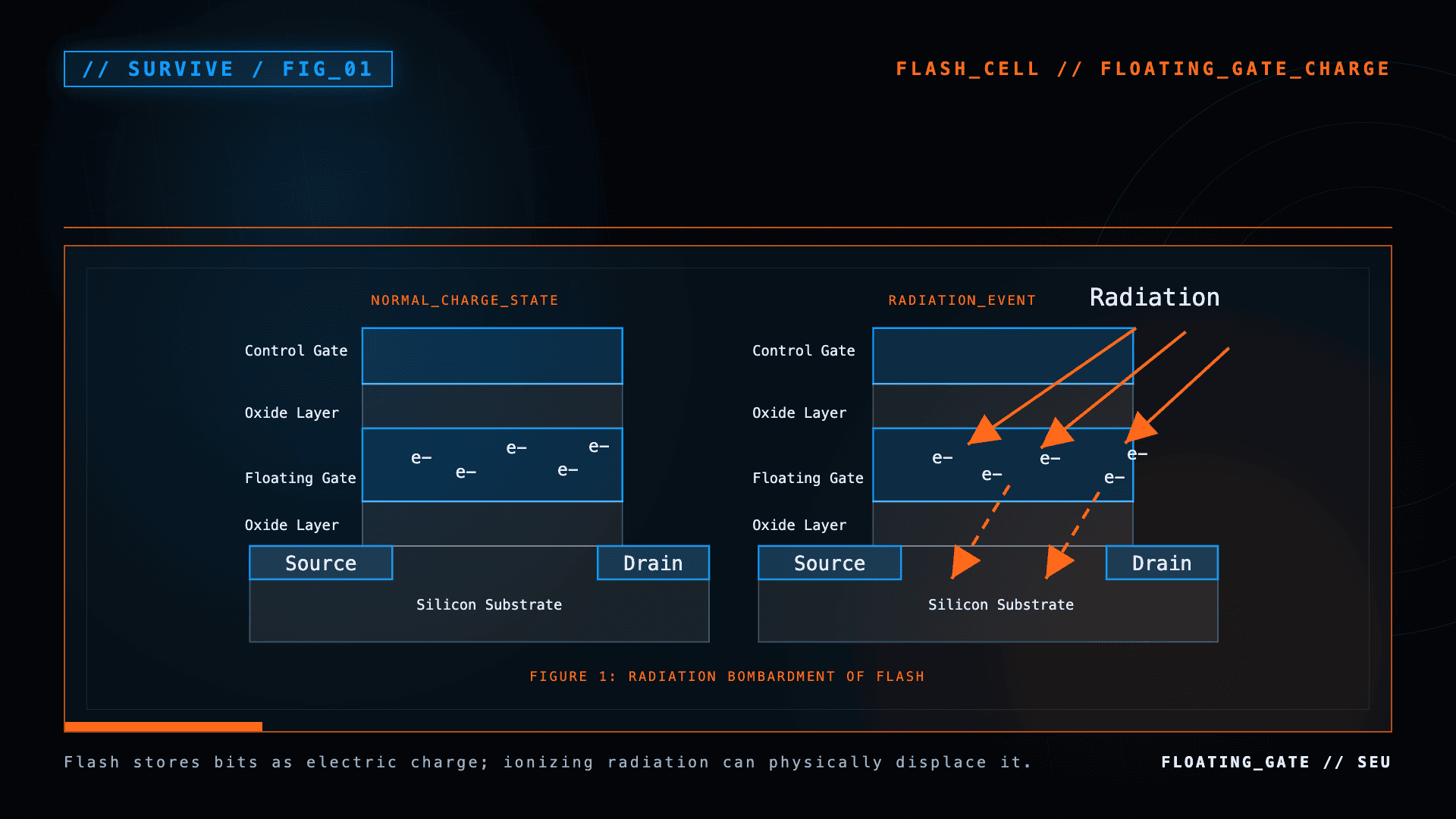
Both NAND and NOR flash are highly susceptible to the effects of radiation, particularly from SEUs. Flash memory cells hold information in a charge trap, where the presence or absence of stored charge (electrons) determines whether the state is a 0 or 1. Radiation can cause the physical displacement of charge, and when enough electrons are removed, the state of the memory cell changes enough to cause a bit error.
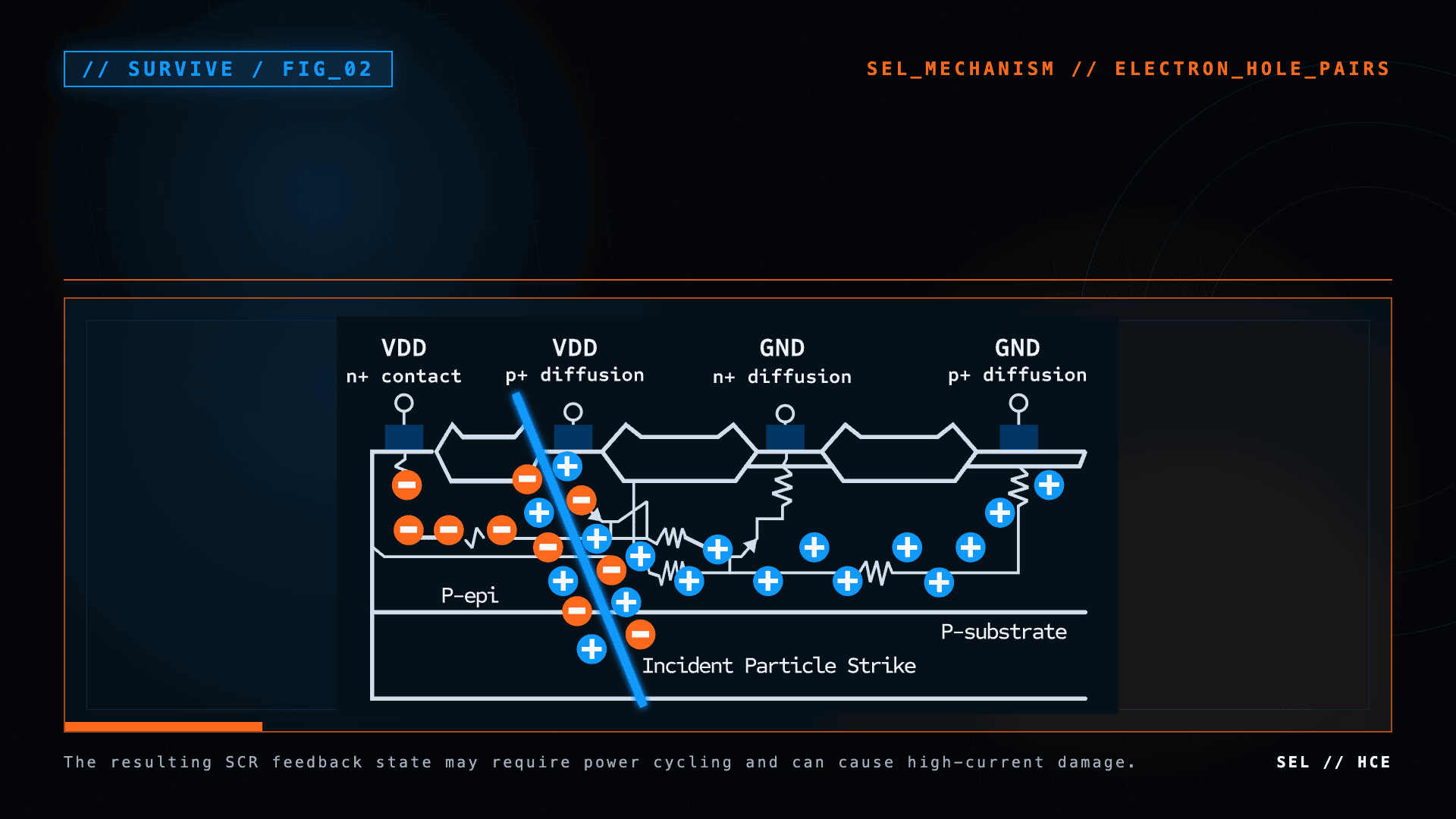
DRAM and SRAM devices are also highly vulnerable to radiation. Their failure state is potentially more destructive as a single-event latchup (SEL). Radiation exposure can cause a low-impedance path between the power and ground rails, resulting in a short circuit, or HCE. This event occurs when a charged particle traveling through the device creates electron-hole pairs along the particle’s path. Charges deposited in sensitive areas of a cell cause parasitic NPN and PNP transistor interactions creating a silicon controller rectifier (SCR) or thyristor structure. This structure forms a feedback loop generating a state that can only be recovered by cycling power.
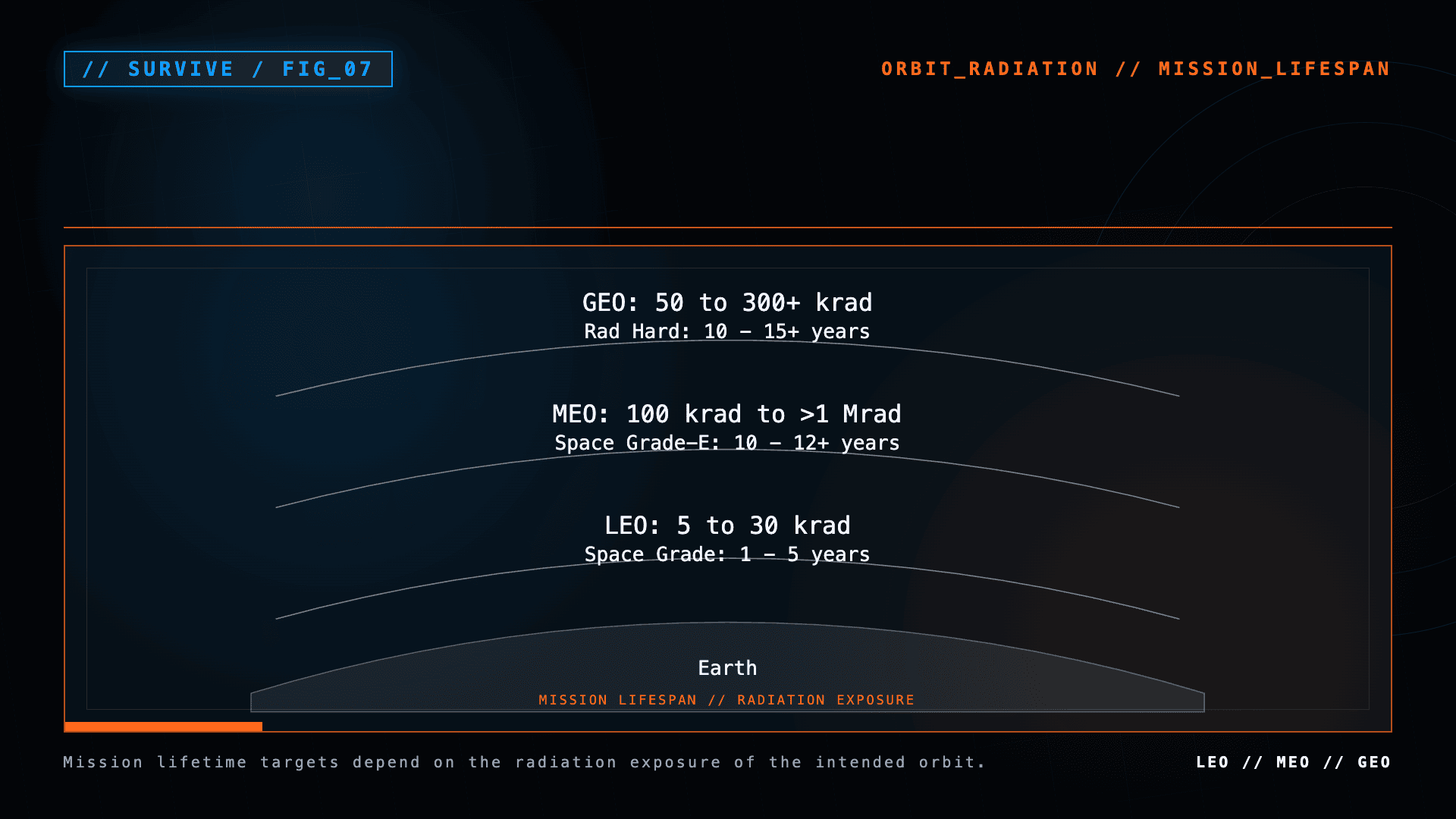
When using common terrestrial memory types in space (e.g. NOR/NAND flash, SRAM, and DRAM), radiation mitigations are a hard requirement. For reliable device operation, failure-recovery modes must be implemented both at a device and at a systems level. Rad-immune designs are the only thing that enable space missions in low-Earth orbit (LEO), medium-Earth orbit (MEO), geostationary orbit (GEO), and beyond, where radiation flux can vary significantly.
SRAM and DRAM
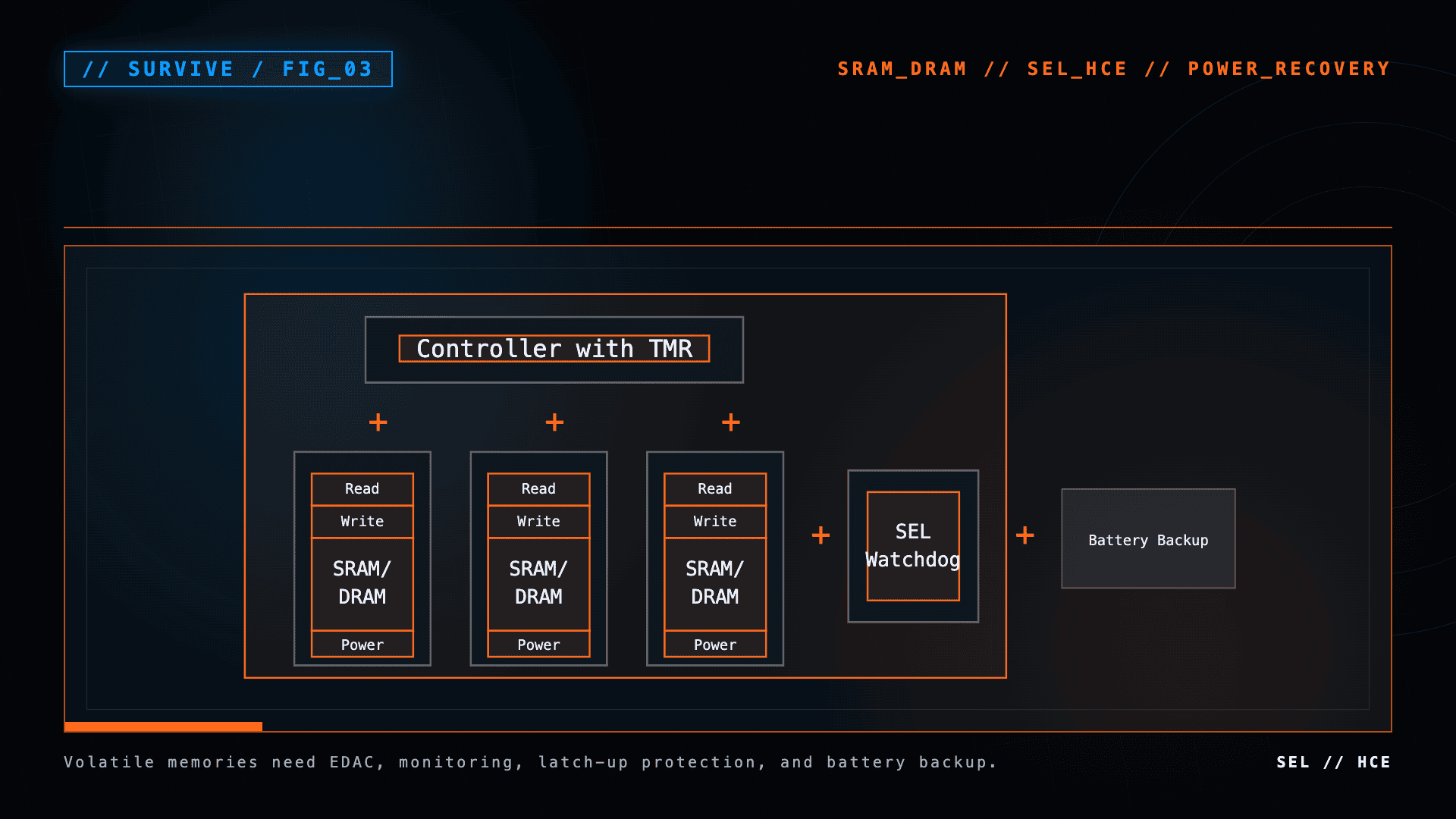
As previously stated, both SRAM and DRAM store their information in charge traps which makes them susceptible to radiation-caused errors like flash memory. Their error state is also more problematic as SELs can cause HCE which in turn can cause permanent damage. Not only do they require similar EDAC schemes for maintaining data integrity, but they need additional monitoring circuitry to catch and reset power related errors from causing damage to the device. Beyond that, they have the additional drawback of being volatile memories. Battery backup solutions, data EDAC, and latch-up detection and protection circuitry create additional layers of system complexity.
Others’ MRAM
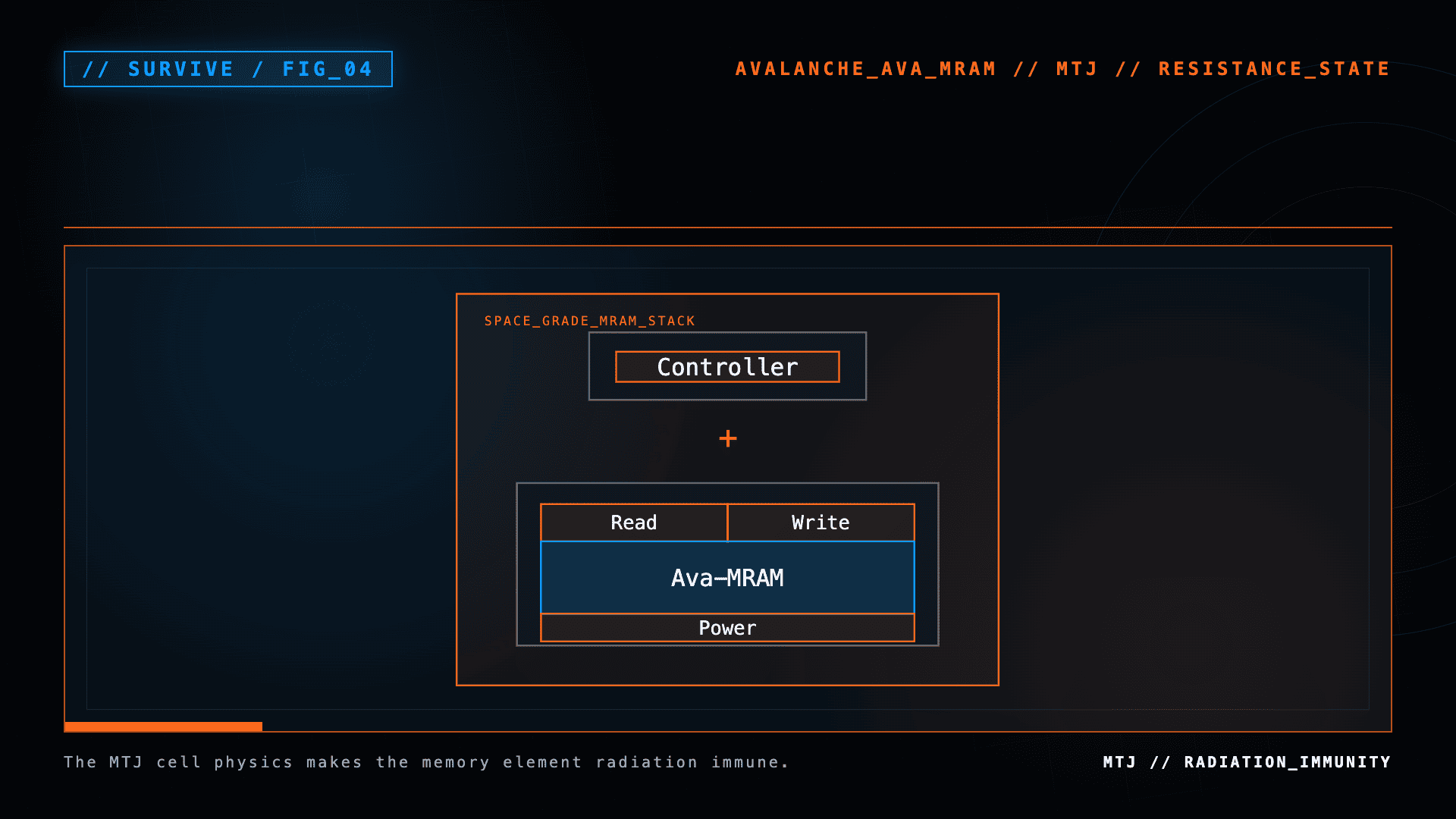
MRAM provides a unique benefit in high radiation environments. The MRAM memory cell operates on a different physics principle to hold data compared to flash memory. Specifically, STT-MRAM stores its information in a Perpendicular Magnetic Tunnel Junction (pMTJ). The pMTJ is itself radiation immune, storing information using resistance rather than electrical charge. STT-MRAM provides the perfect technology platform for building a memory device that can withstand the demanding radiation environment of space. Although a great starting point, in practice, other STT-MRAM solutions still fail on a device level for radiation mitigation. Other components like the read and write circuitry, power delivery circuitry, and potential use of wear leveling circuitry all require radiation immunity to produce a memory device that can survive space.
Avalanche Technology’s Space Grade Ava-MRAM
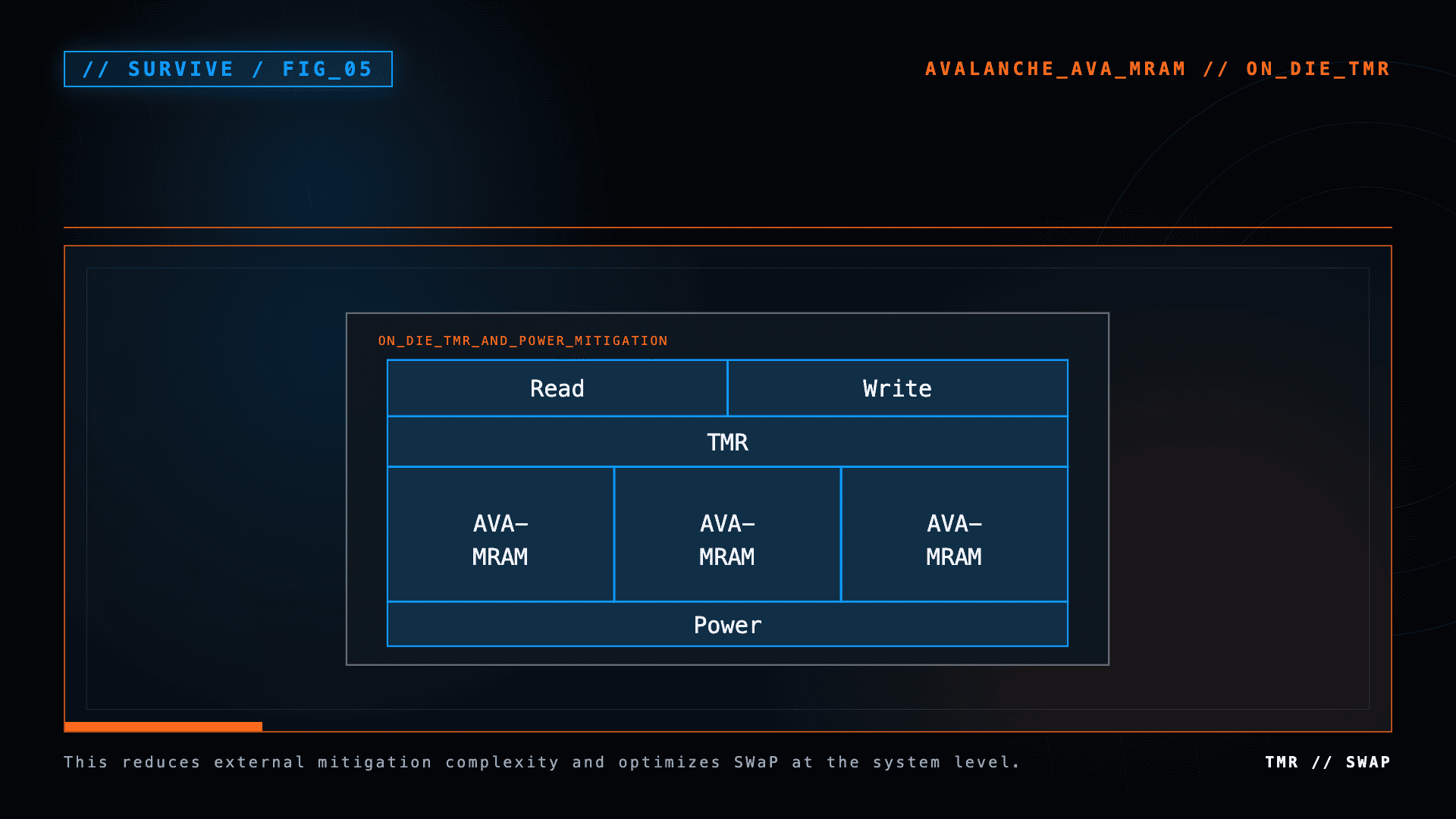
Avalanche Technology’s Space Grade Ava-MRAM distinguishes itself by leveraging both physical properties of the pMTJ and radiation immune circuitry. For the logic circuitry, triple modular redundancy (TMR) is integrated into the die providing data integrity at the lowest level. Additionally, radiation tolerance is built into the power delivery circuitry. This dual approach eliminates the need for complex external redundancies and mitigations which simplifies system design and enhances overall reliability. Within a single memory device, superior radiation tolerance is achieved. Traditional memory technologies like SRAM, DRAM, flash (NOR/NAND), and other STT-MRAM solutions are surpassed in radiation tolerance. Ava-MRAM serves as the ultimate optimization of size, weight, and power (SWaP) for memory devices designed to survive in space.
Radiation Performance Data and Comparative Analysis
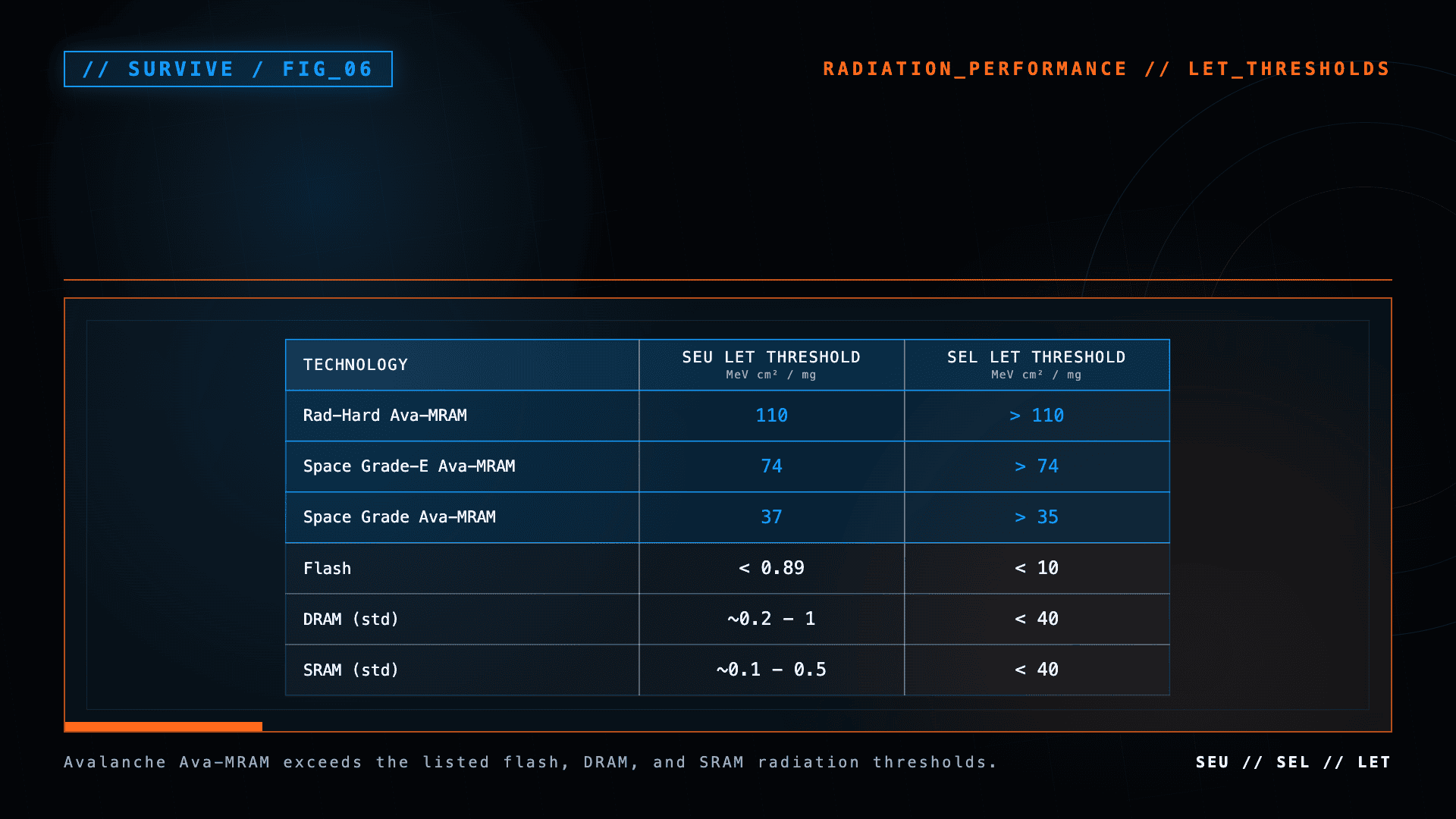
Avalanche’s Space Grade Ava-MRAM demonstrates exceptional radiation tolerance. These results show Ava-MRAM’s superior thresholds, around double those of DRAM/SRAM for SEL and over 84 times that of flash for SEU.
Achieving Space Grade
Avalanche Ava-MRAM has industry leading strengths over other memory solutions for rad tolerant applications. As a standalone device, it easily satisfies the SURVIVE pillar of a true Space Grade component. At its core, it provides a superior radiation tolerant and SWaP optimized component to solve a systems level problem. This is a tremendous step in the democratization of space. Avalanche Ava-MRAM gives confidence to new players in the industry, scientific missions, military defense applications, researchers, students, and all manner of systems integrators that their memory device will survive the harsh environment of space.
Ultimately, there is no one requirement of Space Grade that stands above the rest. Avalanche reaffirms its leadership as the only provider of true Space Grade memory, delivering solutions that meet all five non-negotiable criteria required for space missions: Survive, Retain, Endure, Commit, and Prove. Space Grade technology must survive radiation without disruption, retain data for the life of a mission, endure unlimited writes, commit data instantly, and prove real space heritage.
In space systems, a technology that survives radiation but loses data, wears out over time, delays data commitment, or lacks flight heritage is not Space Grade. Partial compliance leads to failure. Avalanche Space Grade Ava-MRAM uniquely delivers on all 5 criteria simultaneously, through radiation immunity, permanent data retention, unlimited endurance, deterministic nanosecond writes, and proven flight qualification, without tradeoffs.